


.jpg)
Smoke Management
The session brought together two practical topics car park smoke management and corridor smoke purge systems giving engineers the opportunity to explore how these systems should be approached from a real-world design perspective.
When Smoke Becomes the Critical Design Problem
In a fire scenario, smoke can become a greater immediate threat than the fire itself.
Smoke management systems are designed to control, move, and remove smoke in a way that supports safer conditions during an emergency. That makes their design a responsibility that goes far beyond simply selecting fans and routing ducts.
The session focused on understanding the design intent, airflow requirements, system operation, coordination, and authority expectations behind these systems.
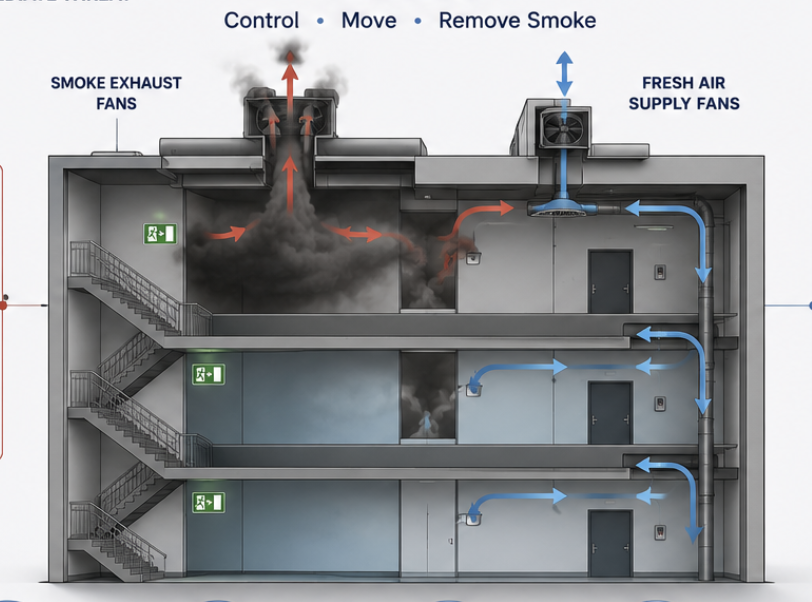
Car Park Smoke Management
Presented by Tabish Hasan
The first session focused on the design of smoke management systems for car parks.
The discussion explored the practical considerations engineers need to account for when developing a car park smoke management strategy, including:
- Airflow requirements
- Fan selection
- Duct and air-path planning
- System control strategy
- Coordination with other services
- Authority requirements
- Emergency operating conditions
The session helped engineers understand how these individual design decisions come together to create an effective smoke management system.
Corridor Smoke Purge Systems
Presented by Shoaib Shaik
The second session focused on corridor smoke purge systems and their role within a building's fire and life safety strategy.
The discussion looked at why smoke control in corridors matters and how the system needs to work as part of the overall emergency strategy.
Engineers explored the importance of understanding the intended airflow path, system operation, coordination with architecture, and the conditions the system needs to support during a fire event.
Beyond Fans, Ducts and Calculations
One of the strongest messages from the event was that smoke management design cannot be approached as a collection of equipment.
A successful system depends on understanding how air moves, how the system operates during an emergency, how different building elements interact, and what the overall life safety strategy requires.
That means engineers need to consider the complete system from design calculations and equipment selection to controls, coordination, approvals, and actual emergency operation.
Key Takeaways
The session highlighted that:
- Car park smoke management requires careful consideration of airflow, fans, duct routing, controls, and authority requirements.
- Corridor smoke purge systems form an important part of a building's fire and life safety strategy.
- Smoke management systems need to be coordinated closely with architecture and other MEP services.
- Emergency operating conditions must be considered during design.
- Good smoke management design requires more than calculations — it requires understanding the complete safety strategy.
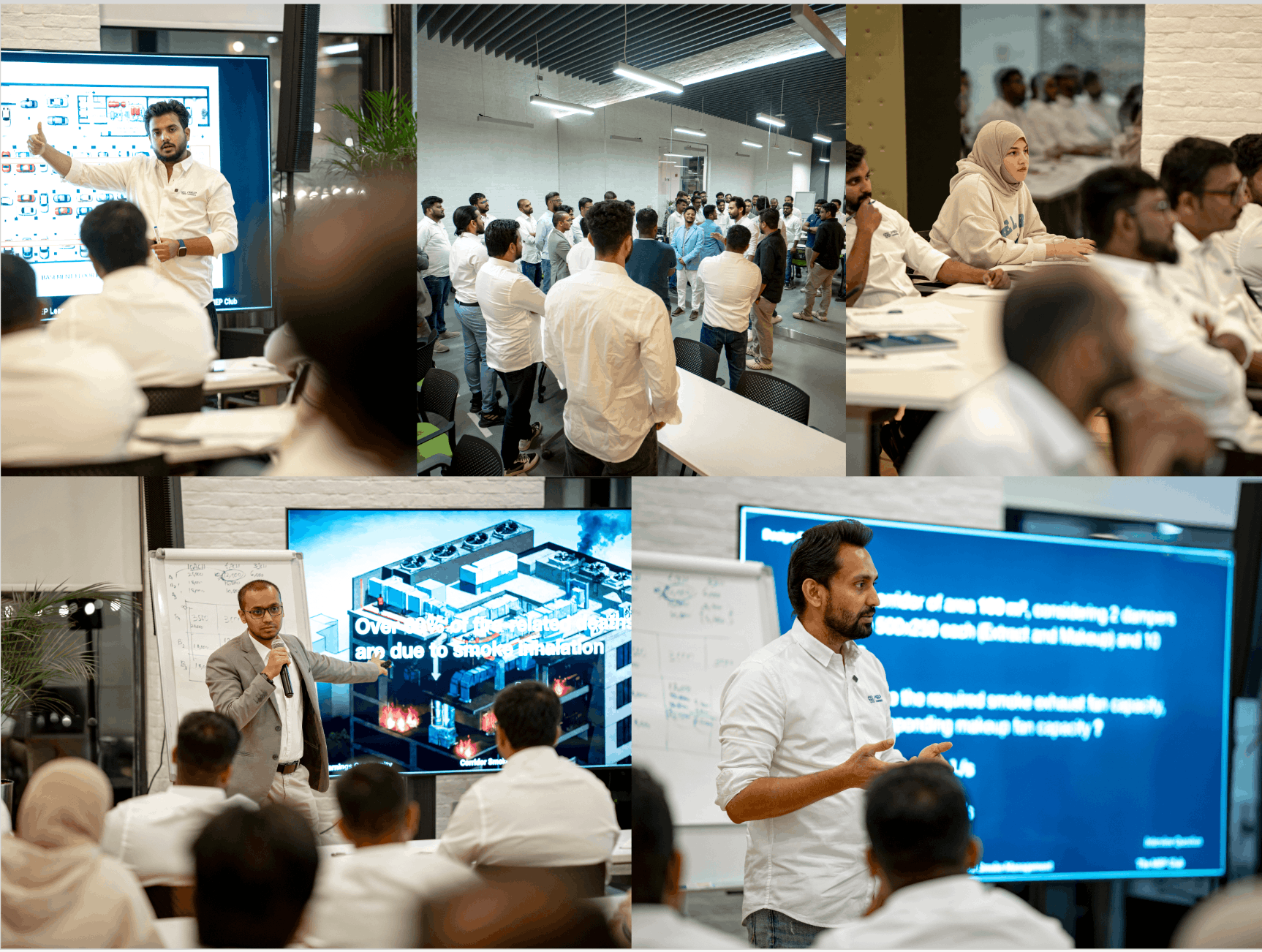
Event Pictures
Designing for the Emergency, Not the Drawing
Smoke management is one of those areas where engineering decisions can have consequences far beyond system performance.
A fan, duct, control sequence, or airflow calculation may appear as a line item on a drawing, but during an emergency, those decisions become part of a system intended to protect people.
This event reinforced the importance of approaching fire and life safety design with technical accuracy, clear intent, proper coordination, and a strong understanding of how the system must perform when it matters most.