


Here is a list of 25 interview questions on plumbing:
What is a water hammer arrestor?
Ans) It is used to absorb the shocks in the water supply piping & hence avoid damage to the pipes, mixers, shut-off valve, etc. It is installed before the last point on the supply line in the bathroom.

What is the pressure requirement at mixers?
Ans) 1.5 Bar
Where are gate valves used in the water supply?
Ans) For every bathroom, toilet, and kitchen so that al the areas are not stopped for maintenance.
The main entrance of pipes to flats.
Water meter room.
Water pumps (before & after), etc.

What is the difference between gravity and boosted line?
Ans) First 3 floors are provided with booster pumps so as to have 1.5 Bar pressure at mixers/outlets
For proper functioning. Other floors are with gravity since the pressure increases at lower floors due to gravity.
What is the function of the booster pump set?
Ans) To increase the pressure in the top 5 floors to have 1.5 bar pressure at the mixer/outlet for proper functioning.
What is the loading unit in the water supply system?
Ans) Loading units are the corresponding values given to each fixture used in the building which has to be served by the pressurized booster pump. Total loading units give the flow rate in liter/sec which shall be required for the booster pump.
How is the transfer pump head calculated?
Ans) H = (Static head) + (Friction loss of pipes & fittings on the longest length) + 0.5 bar tank discharge pressure.
How is transfer pump flow calculated?
Ans) Transfer pump flow (GPM) = overhead water tank capacity / 240 mins (i.e. min 4 hours initial filing time).
How is booster pump flow calculated?
Ans) It is calculated based on the number of loading units.
How is the booster pump head calculated?
Ans) Booster Pump head (H) = Discharge pressure + friction losses in pipes & fittings.
What is the function of the float switch in the water supply?
Ans) Float switches are installed in the overhead water tanks which give a signal to transfer pumps for starting & stopping the supply. (i.e. when the float switch floats up it stops the supply and when it goes it starts the supply).
What is the difference between duty + standby & Duty + assist in the pump sets?
- Ans) Duty + Stand-by pumps - Works one by one.
Duty + Assist pumps - One starts and, if required, the second also starts working.
- Cyclic changeover for the pump run time is provided to have uniform wear & tear.
What is the safety valve in the water heater and where it is installed?
Ans) It is in the supply line (i.e. cold/normal water line) of the water heater to avoid backflow of hot
water in the cold-water line. It is also used to relieve excess pressure in the water heater
manually.
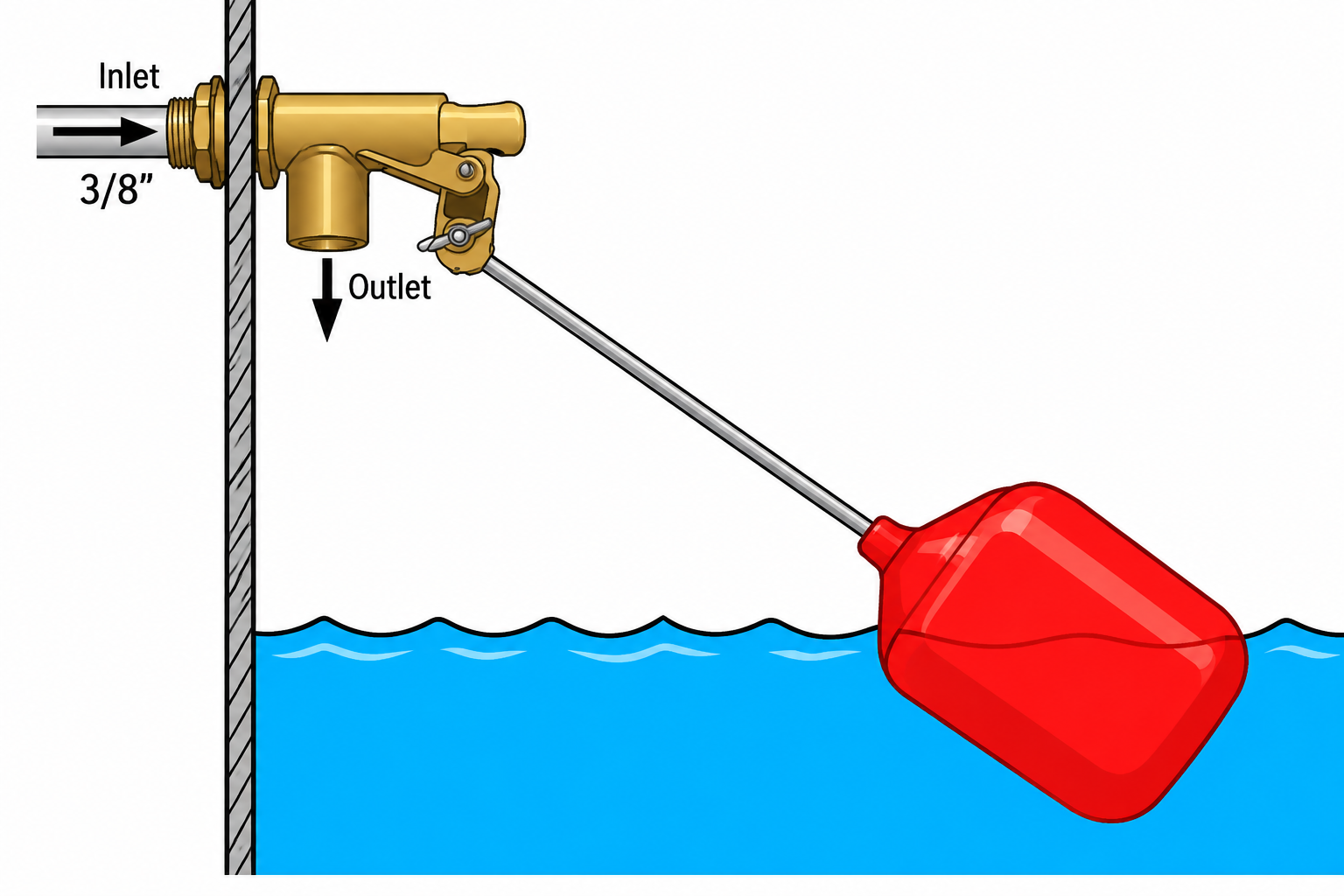
What is a Float valve?
Ans) A float valve is installed on the inlet pipe of the tank to start & stop the supply.
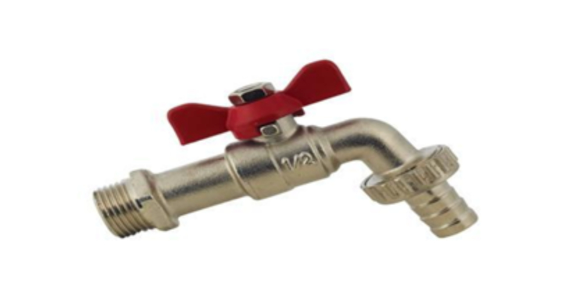
What is bib taps and where it is used?
Ans) Bib taps are used in:
- Parking
- Garbage rooms
- B a s e m e n t s
It may also be called Garden taps if used in gardens.
What is the typical water supply inlet pipe size from DEWA?
Ans) 50mm - 75mm
What is the typical water meter size for a building i.e. main water meter size?
Ans) 1" = 25 mm
What is the DEWA requirement for the water meter cabinet & water meter installation?
Ans) Distance between pipes must be 20 cm from all sides.
The distance between FFL and the water meter must be 120 cm.
Draw connection details for the water meter in the water meter cabinet?
Ans)

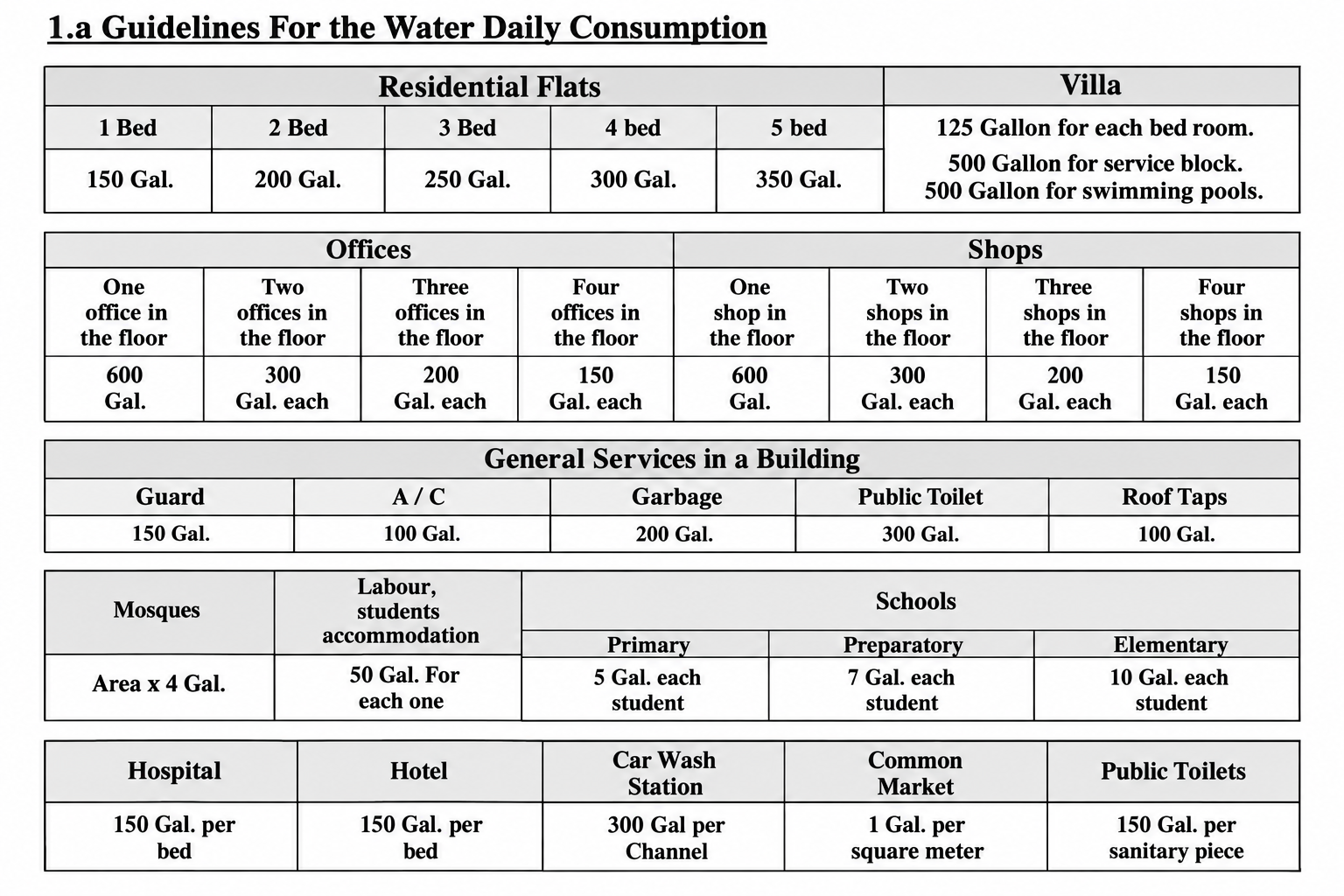
What is the daily water consumption requirement as per DEWA?
Ans)
How to calculate underground/ground water tank capacity?
Ans) It is the total Domestic water requirement and fire water reserve
- For domestic water supply refer to the above sheet.
How to calculate overhead water tank capacity?
Ans) It wil be 25% of daily domestic usage.
What is the sterilization of the water supply system?
Ans) It is the process of cleaning the pipelines and water tank of impurities after installation at the time of final testing and commissioning before the final handover of the project.
What is the working pressure and testing pressure for the water supply system?
Ans) 1.5 Bars is the working pressure. 1.5 times the working pressure or a minimum of 10 Bars is the testing pressure.
Why is PRV used in a water supply riser?
Ans) To limit the working pressure not to exceed 2 bars.