

Introduction
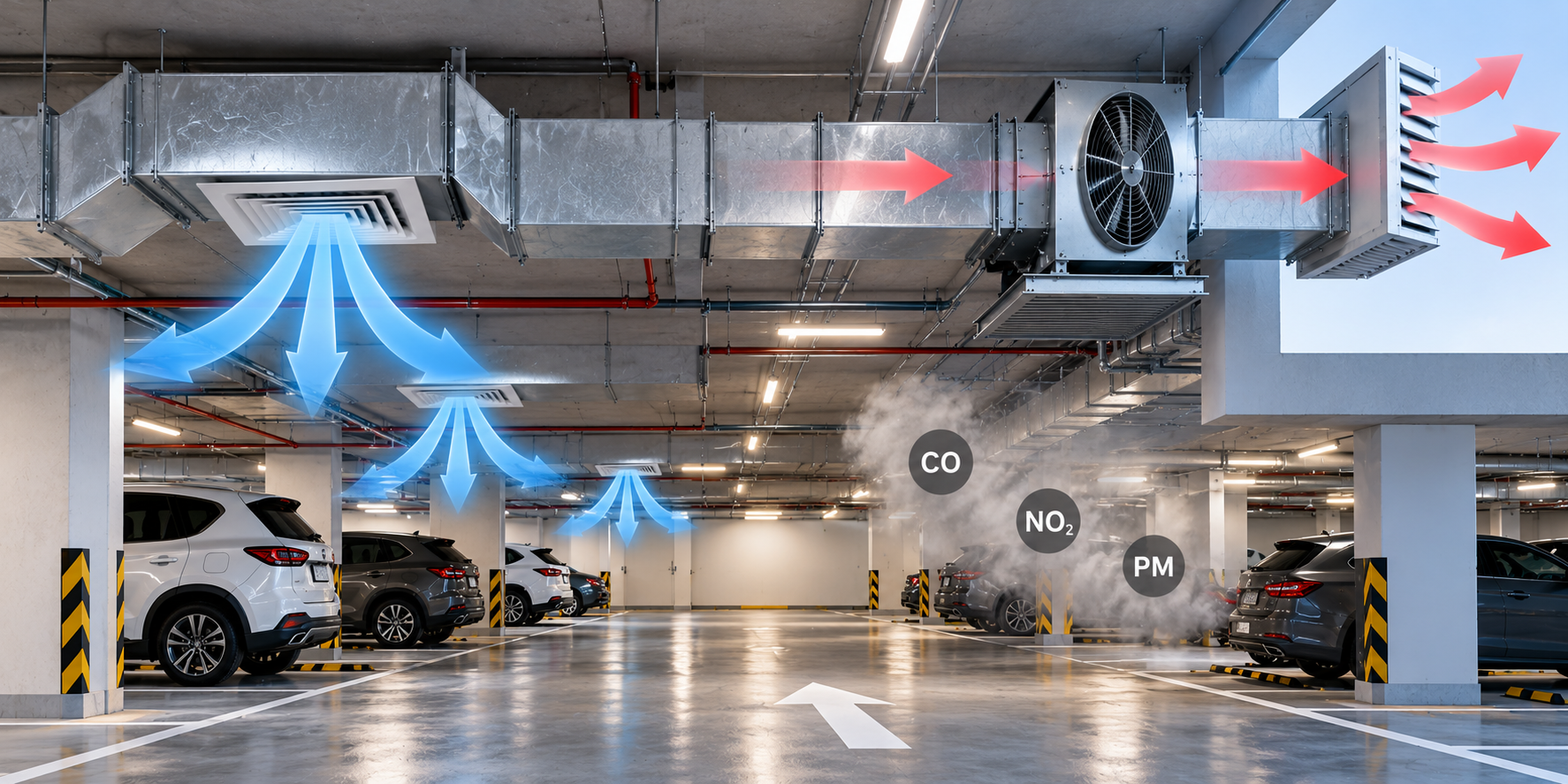
A car park ventilation system is designed to ensure air quality and safety in parking structures by controlling the buildup of vehicle exhaust gases, ensuring proper airflow, and maintaining safe oxygen levels. Ventilation in car parks is important to prevent the accumulation of harmful gases like carbon monoxide (CO) and nitrogen dioxide (NO₂) and to keep the air fresh for drivers and pedestrians. Here’s a simple explanation of how it works, broken down into key topics:
Purpose of Ventilation in Car Park
- Ventilation helps to remove pollutants from vehicle emissions, such as carbon monoxide, hydrocarbons, and nitrogen oxides, which can build up in enclosed spaces.
- Proper ventilation ensures there is enough fresh air for people to breathe and helps prevent dangerous situations like asphyxiation or suffocation from lack of oxygen or high levels of toxic gases.
- It helps maintain a comfortable environment by reducing the build-up of heat and humidity, especially in underground or enclosed parking structure.
Types of Car Park Ventilation Systems
1. Natural Ventilation
- Relies on natural forces like wind and temperature differences to circulate air. Vents, openings, and ducts are placed in the car park's structure to allow air to flow through.
- Low cost and low maintenance.
- Less effective in large, enclosed spaces or areas with low airflow.
2. Mechanical Ventilation
- Uses fans, blowers, and exhaust systems to actively circulate air. This system is more controlled and effective than natural ventilation, especially in multi-story or underground car parks.
- Types of Mechanical Systems:
- Exhaust fans are used to expel polluted air out of the car park.
- Supply fans are used to bring in fresh air from the outside.
- Mixed systems are a combination of exhaust and supply fans to create a balanced airflow.
Hybrid Systems
Combines natural and mechanical ventilation means Mechanical ventilation is activated when natural airflow isn’t sufficient, such as during peak times or in more enclosed areas of the car park.
Key Design Considerations
- Air Changes per Hour (ACH)
- ACH measures how often the air in the parking structure is replaced in one hour. For example, an ACH of 10 means the air is completely replaced 10 times in one hour.
- Depending on the size and type of the car park, typical ACH values range from 3 to 10. Higher ACH is required for car parks with more vehicles or higher levels of pollutants.
- Local codes and standards (like those from the NFPA or ASHRAE) often define minimum ACH requirements for car parks.
- Pollutant Control
- CO (Carbon Monoxide) is a toxic gas produced by car engines. It is one of the main targets of a car park ventilation system.
- NO₂ (Nitrogen Dioxide) is a Another harmful gas from vehicle emissions that needs to be removed.
- Particulate Matter (PM) is a Dust and particles from exhaust fumes or tires that the system helps mitigate.
- Ventilation Rate Calculation
- To determine the number of fans and the size of ducts, engineers consider the volume of the car park, the desired ACH, and the amount of pollutants expected.
- Ventilation requirement formula:

Ventilation System Components
Exhaust Fans
Exhaust fans remove contaminated air from the car park and discharge it through designated exhaust outlets.
Supply Fans
Supply fans introduce outdoor air to replace the extracted air and support the intended airflow pattern.
Ductwork
Ductwork distributes supply air or collects exhaust air where a ducted arrangement is required. Duct sizing must account for airflow, pressure losses, noise, and available space.
Air Inlets and Exhaust Outlets
Inlets allow outdoor air to enter the parking area, while exhaust outlets discharge contaminated air. Their locations should be coordinated to reduce short-circuiting and ineffective ventilation.
Sensors and Control Systems
CO and, where required, NO₂ sensors monitor pollutant concentrations. The control system can adjust fan operation based on measured conditions, subject to the approved control strategy.
Other components may include variable-frequency drives (VFDs), control panels, dampers, and monitoring interfaces.
Ventilation Strategies
Demand-Controlled Ventilation (DCV)-
Demand-controlled ventilation adjusts fan operation according to monitored pollutant levels or other approved control inputs.
When pollutant concentrations rise, the system increases ventilation as required. When conditions improve, fan speed may be reduced, provided minimum ventilation and safety requirements continue to be met.
Benefits:
- Reduced energy consumption under suitable operating conditions
- Improved control of ventilation demand
- Potentially lower operating costs
Constant-Volume Ventilation-
A constant-volume system operates at a relatively fixed airflow rate, irrespective of changes in vehicle activity or pollutant concentrations.
Benefits:
- Simple control strategy
- Predictable airflow during operation
Limitations:
- May consume more energy during periods of low demand
- Does not automatically respond to changes in pollutant levels unless additional controls are provided
Maintenance and Monitoring
- To ensure the system works effectively, the ventilation system should be regularly inspected for blockages, dirt, or damaged components. Fans, ducts, and filters need periodic cleaning and maintenance.
- Many modern systems come with automated monitoring, logging, and alert systems that can notify operators when ventilation is insufficient, or a fault occurs.
Energy Efficiency Considerations
- Fan Speed Control: Modern systems use variable-speed fans that adjust speed based on air quality or car park activity, reducing energy consumption.
- Energy Recovery: Some systems incorporate heat recovery mechanisms to use the exhaust air's thermal energy to pre-condition the incoming fresh air, saving on heating or cooling costs.
Summary
A car park ventilation system removes vehicle exhaust pollutants and maintains acceptable air quality in enclosed parking facilities. System selection and design depend on the building layout, required airflow, pollutant limits, and applicable codes.
Correct airflow calculations, effective air distribution, suitable controls, and regular maintenance are essential for safe and energy-efficient operation.
Important distinction: Normal car park ventilation and fire-related smoke extraction are separate design functions. Where a system is required to perform both, its design, equipment, controls, and operating modes must meet the applicable fire and life-safety requirements.