


Natural Ventilation vs. Mechanical Ventilation
Both mechanisms are vital in a smoke management system.
Let's understand the basics:
Natural Ventilation:
A method of supplying or removing air from a space through openings on the exterior of a building, using natural air movement from outside.
Mechanical Ventilation:
A method of supplying or removing air from a space with the aid of mechanically operated equipment such as fans and ductwork.
Provision of natural ventilation to enclosed spaces, stairs, corridors, etc., is intended to clear smoke accumulated during and after fire emergencies, or to overcome fungus or dampness, or to provide ventilation.
Provision of mechanical ventilation to enclosed spaces, fire pump rooms, generator rooms, stairs, corridors, etc., is intended to overcome fungus or dampness, or to clear smoke accumulated during and after fire emergencies.
What Is ACH?
The most critical parameter considered in smoke management calculations is ACH.
Air Changes per Hour (ACH): A measure of the volume of air added to or removed from a space in one hour, divided by the volume of the space.
Corridors and open circulation areas shall be provided with a mechanical smoke purge system.
However, there are some exceptions where mechanical ventilation can be avoided in corridors.
The intent of the smoke purge system is to remove smoke for firefighting operations during and after a fire.
- The corridor smoke purge mechanical system shall achieve a minimum of 6 air changes per hour (6 ACH).
- Mechanical air supply inlets shall achieve a minimum of 85% of the extract airflow rate.
Reference: Dubai Civil Defense Regulations

CO Exposure
Excessive exposure to carbon monoxide (CO) can cause death.
Every year, at least 430 people die in the U.S. from accidental CO poisoning.
- Carbon monoxide (CO) is a colourless and odourless gas found in fumes produced by incomplete combustion, such as those from cars and trucks, lanterns, stoves, gas ranges, and heating systems.
- CO from these fumes can build up in places without a good flow of fresh air, such as cars with windows rolled up, closed rooms, kitchens, and garages, and can cause poisoning.
- Common symptoms of CO poisoning include headache, fatigue, dizziness, nausea, vomiting, and chest pain. Excessive exposure can cause death.
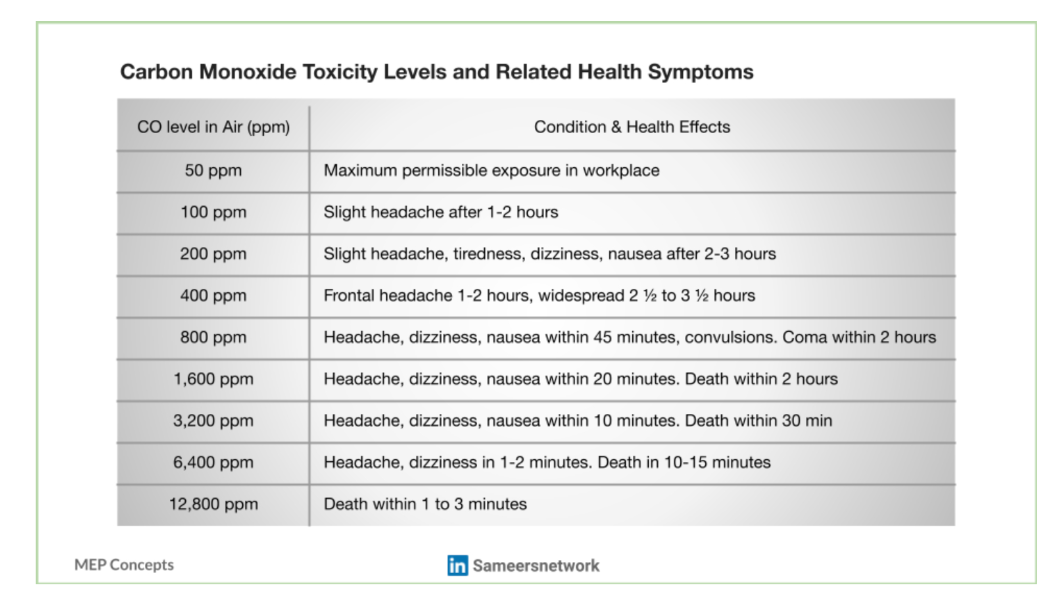
The image below explains the condition and health effects based on the CO level in the air.
* Parking garages in residential/commercial buildings have become widespread with
increased population and vehicle usage.
Although vehicles release many exhaust gases within the exhaust gas of the cars, carbon
monoxide is the primary gas requiring detection & control.
* Levels of carbon monoxide in parking garages vary depending on:
1. Number of cars running
2. Length of travel and operation time of cars in the parking garage
3. Emission rate of vehicle
4. Acceptable contaminant level within a given facility
- Due to energy and environmental concerns, many jurisdictions worldwide have
mandated CO sensing control systems for new parking garages.
Points to Consider for CO Monitoring in Building Services
Design Criteria
- Mechanical ventilation must be provided to ensure that the carbon monoxide (CO) concentration in the enclosed parking area is maintained below 50 parts per million (ppm), by providing a minimum of six outside air changes per hour.
- CO monitoring equipment must be installed with a minimum of one CO sensor per 400 square metres (m²) of parking floor area. A sound alarm should be triggered when the CO concentration reaches or exceeds 75 ppm in at least 5% of the monitored locations.
- CO monitoring equipment must be checked and recalibrated every six months, or according to the manufacturer's specifications, by a specialised calibration company certified by the local authority.
- Where a Building Management System (BMS) or Central Control and Monitoring System (CCMS) is installed, the CO concentration must be monitored to allow real-time profiling and management of air quality.
Installation Criteria
Carbon monoxide (CO) gas has a slightly lower density than air.
The recommended mounting height for a CO gas detector is 1.5 m above the floor, as stated in the source.
Note: Core and other specific detector installation requirements should be verified against the applicable UAE standards and local authority regulations.