

Scope and Purpose
This method statement outlines the procedures and requirements for the on-site installation of ventilation fans in HVAC systems. It covers pre-installation checks, installation procedures, quality control inspections, and safety measures to ensure that the work complies with approved drawings, project specifications, and manufacturer recommendations.
Reference Documents
The following documents shall be referred to during the installation process:
- Project specifications
- Latest approved shop drawings
- Approved material submittals
- Manufacturer's installation instructions
- Applicable project quality and safety requirements
General
Fans shall be installed at the locations indicated in the approved shop drawings. The type of fan used shall depend on the ventilation and pressurization requirements of the project.
Common types of fans used in HVAC systems include:
- Toilet Extract Fans (TEF)
- Kitchen Extract Fans (KEF)
- Lobby Pressure Relief Fans (LRF)
- Stairwell Pressurization Fans (SPF)
- Car Park Exhaust Fans
- Jet Fans
All tools and equipment shall be inspected before use and confirmed suitable for the intended work.
Method of Pre-Installation
Before starting the installation, the following checks shall be completed:
- Ensure that all approved materials required for the installation are available at the site.
- Verify the fan nameplate details against the approved shop drawings, equipment schedules, and material submittals.
- Inspect the installation area and access routes to confirm that the site is ready for the work.
- Ensure that all relevant drawings, specifications, and other applicable documents are available and approved.
- Inspect the fans and associated materials for physical damage before transferring them from the storage area to the installation location.
- Brief the installation team on the approved drawings, installation sequence, and specific requirements of the work.
- Verify that the tools, lifting equipment, and access equipment are suitable and in good working condition.
- Explain the required safety precautions, personal protective equipment (PPE), and safe working procedures to all personnel involved.
Any damaged equipment, missing components, or discrepancies shall be reported and resolved before installation begins.
Method of Installation
The installation shall be carried out in the following sequence:
- Coordinate the installation activities with other MEP services to avoid clashes and ensure sufficient installation and maintenance clearance.
- Inspect the fan assembly to confirm that it is free from damage and that all internal components are complete and in good condition.
- Transport the fan assembly carefully to the designated installation location using suitable handling and lifting methods.
- Install the fan in accordance with the manufacturer's instructions and the approved material submittals.
- Position the fan at the location and in the orientation indicated in the approved shop drawings.
- Ensure that the fan is properly supported, aligned, and secured before proceeding with ductwork and electrical connections.
- Complete the installation checks and inspections required by the project quality plan.
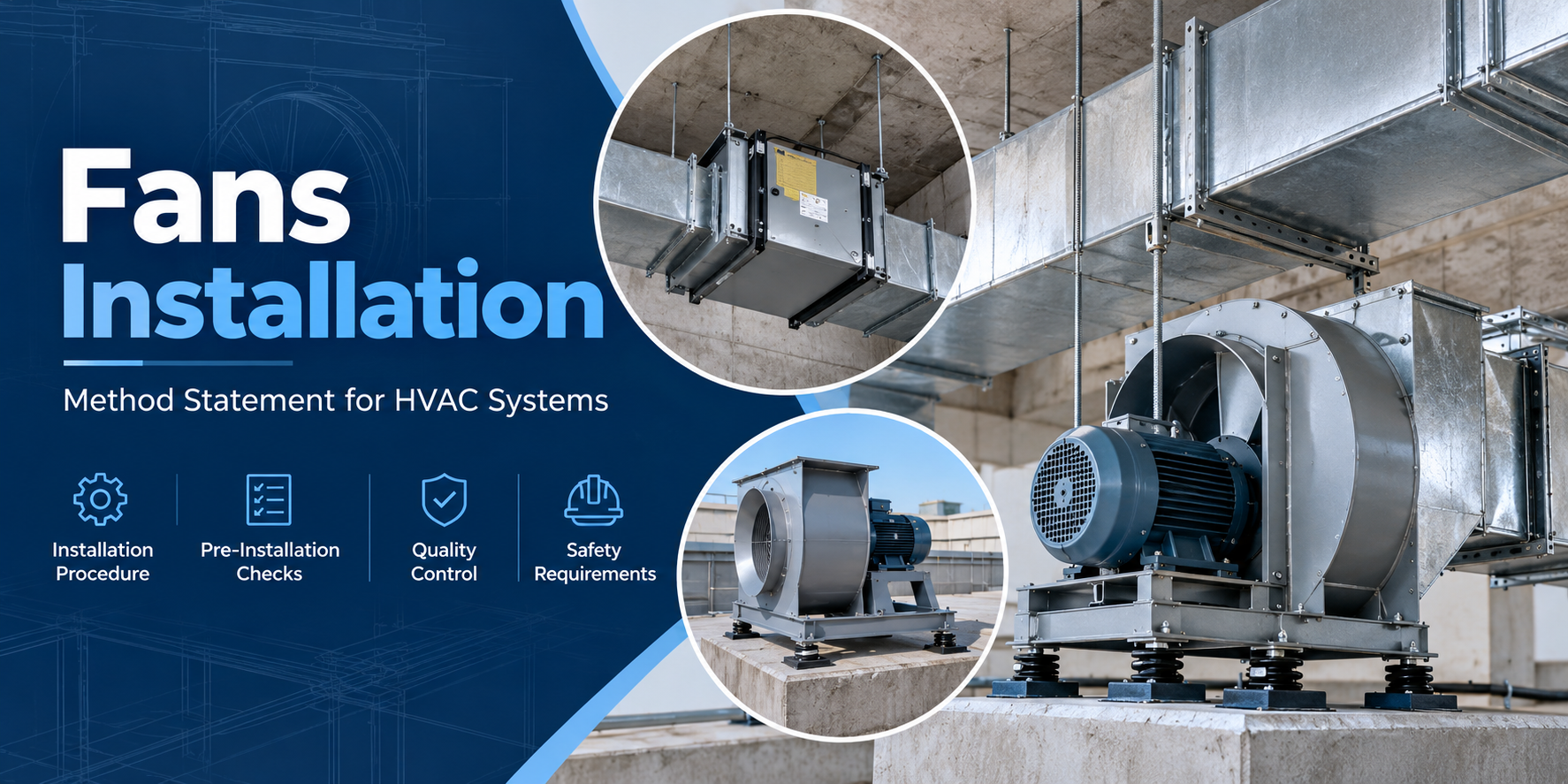
Installation of Floor-Mounted Fans
For floor-mounted fans, the following procedure shall be followed:
- Verify that the concrete foundation or builder's work base has been provided in accordance with the approved shop drawings.
- Check the foundation level using a spirit level and confirm that the supporting surface is suitable for installation.
- Verify the foundation dimensions, anchor locations, and fan orientation before positioning the equipment.
- Install the approved vibration isolators in the specified locations in accordance with the approved submittals and manufacturer's recommendations.
- Position the fan assembly and secure its mounting brackets to the vibration isolators as specified by the manufacturer.
- Check the fan alignment, stability, and level before completing the installation.
- Complete the associated ductwork and damper installation in accordance with the approved shop drawings.
- Ensure that the ductwork does not impose unintended loads on the fan casing and that flexible connections are provided where specified.
Installation of Inline-Mounted Fans (Ceiling-Suspended)
For ceiling-suspended inline fans, the following procedure shall be followed:
- Confirm whether the fan is to be mounted horizontally or vertically, as indicated in the approved shop drawings and permitted by the manufacturer.
- Install the required supports using threaded rods, mounting brackets, or other approved suspension arrangements in accordance with the manufacturer's recommendations.
- Provide the specified vibration isolators at the mounting points where required.
- Secure the fan assembly and verify that the supports are stable and adequately installed.
- Connect the associated ductwork and dampers in accordance with the approved shop drawings.
- Ensure sufficient access and maintenance clearance for the removal of access covers, fan components, and motor assemblies.
- Complete the electrical connections in accordance with the approved electrical drawings and the manufacturer's terminal diagram.
- Provide earthing in accordance with the approved electrical design and applicable requirements.
- Label electrical connections where required by the approved schematics and project specifications.
- Verify the fan rotation before completing the final duct connection, where practicable and safe to do so. Any electrical testing or energization shall be carried out by authorized personnel using the approved procedure.
Quality Control
Quality control inspections shall be carried out to verify that the installation complies with the approved project requirements.
The following checks shall be performed:
- Verify the fan model, capacity, and other relevant equipment details against the approved submittals.
- Check the fan location, orientation, mounting arrangement, and alignment against the approved shop drawings.
- Inspect the foundations, supports, anchor fixings, and vibration isolators.
- Verify that ductwork and damper connections are correctly installed.
- Check the availability of maintenance access and removal clearances.
- Verify electrical connections, earthing, and labeling against the approved electrical drawings.
- Confirm that installation defects and non-conformities are corrected before requesting final inspection.
The QC Engineer, in coordination with the Project Engineer and Site Supervisor, shall monitor the installation to ensure compliance with the contract specifications and approved submittals.
An Inspection Request (IR) shall be submitted to the Main Contractor and/or Consultant in accordance with the project's inspection and testing procedures.
Safety Requirements
All installation activities shall comply with the approved project safety plan, applicable regulations, and site-specific safety procedures.
The following precautions shall be observed:
- Ensure that personnel use appropriate PPE, including safety helmets, safety footwear, gloves, and eye protection, as required.
- Use suitable scaffolding or approved access platforms for work at height. Where required, use an approved fall-protection system with a suitable anchor point.
- Ensure that all lifting operations are planned and supervised by competent personnel using inspected and approved lifting equipment.
- Keep personnel clear of suspended loads during lifting and positioning operations.
- Isolate electrical supplies and follow lockout/tagout procedures before carrying out work that could expose personnel to electrical or mechanical hazards.
- Ensure that only authorized personnel perform electrical connections, testing, and energization.
- Maintain good housekeeping and remove packaging, scrap materials, and debris from the work area.
- Ensure that the Safety Officer or designated competent person monitors lifting activities and other high-risk operations as required.
- Stop work and report any unsafe conditions before proceeding.
References
- MEP Planning Manual by Mr. Gulshan Kumar
- Approved project specifications and shop drawings
- Approved material submittals
- Relevant fan manufacturer's installation and maintenance instructions